Datacenter & Infrastructure Engineering
Colocation and data center engineering: we set up rack layout, power and cooling capacity, cabling and hardware placement to carry your growth.
What we deliver
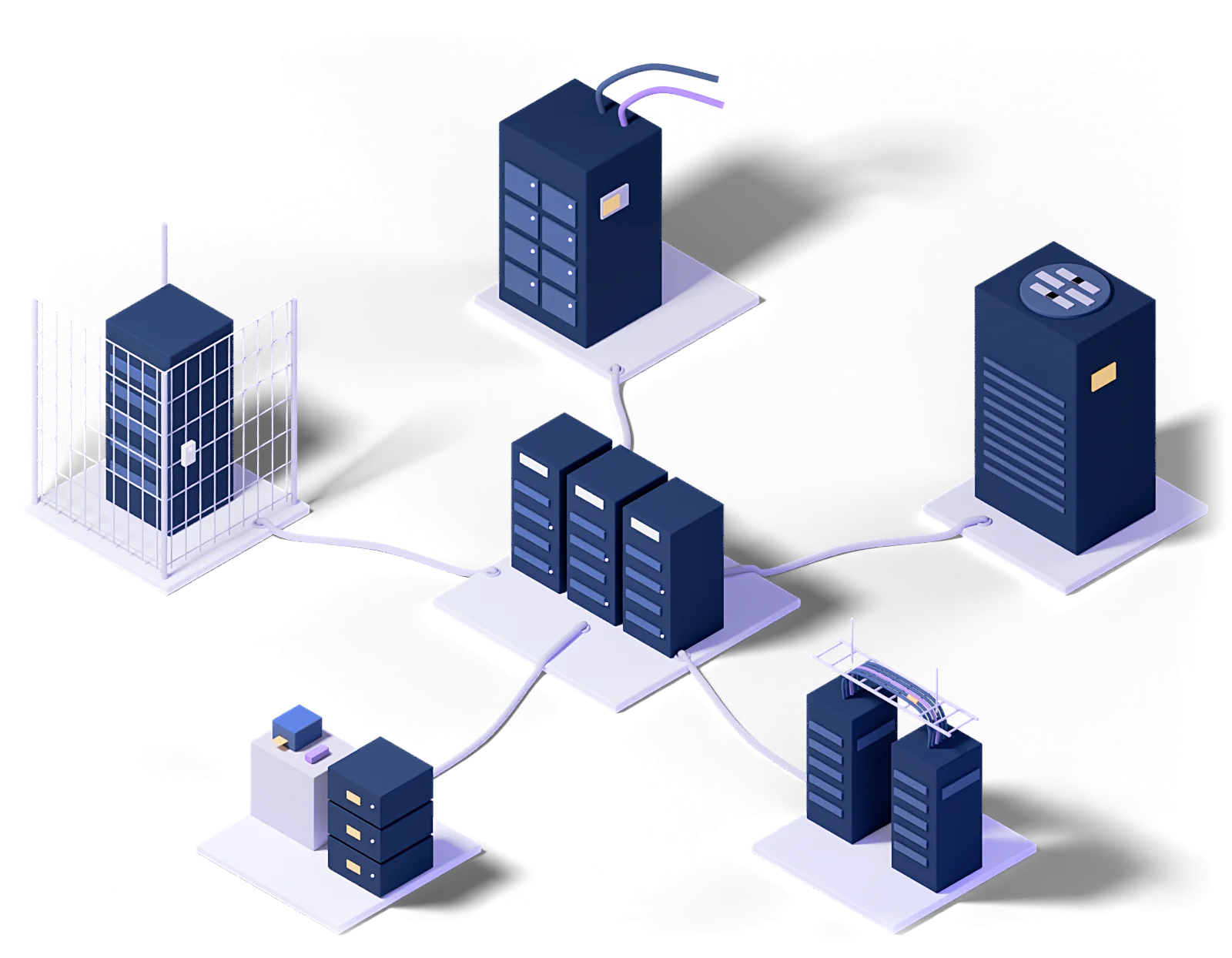
Rack layout, unit placement and weight distribution planned. Power and cooling capacity for dense servers calculated in advance rather than discovered after installation.
Dual feed, UPS capacity and generator start time verified. Redundancy is proven by testing it, not by its presence on a diagram.
Hot and cold aisle containment, airflow management and hotspot monitoring. Dense GPU and compute racks assessed separately for thermal load.
Copper and fiber cabling installed to standard, labeling discipline maintained and the connection map kept current. An unlabeled cable is time lost during a fault.
Server, storage and network hardware recorded with serial number, warranty status and location, so it is known where spare parts will come from before they are needed.
Rack and floor access authorized, entry records kept, and access evidence ready for audit.
How it works
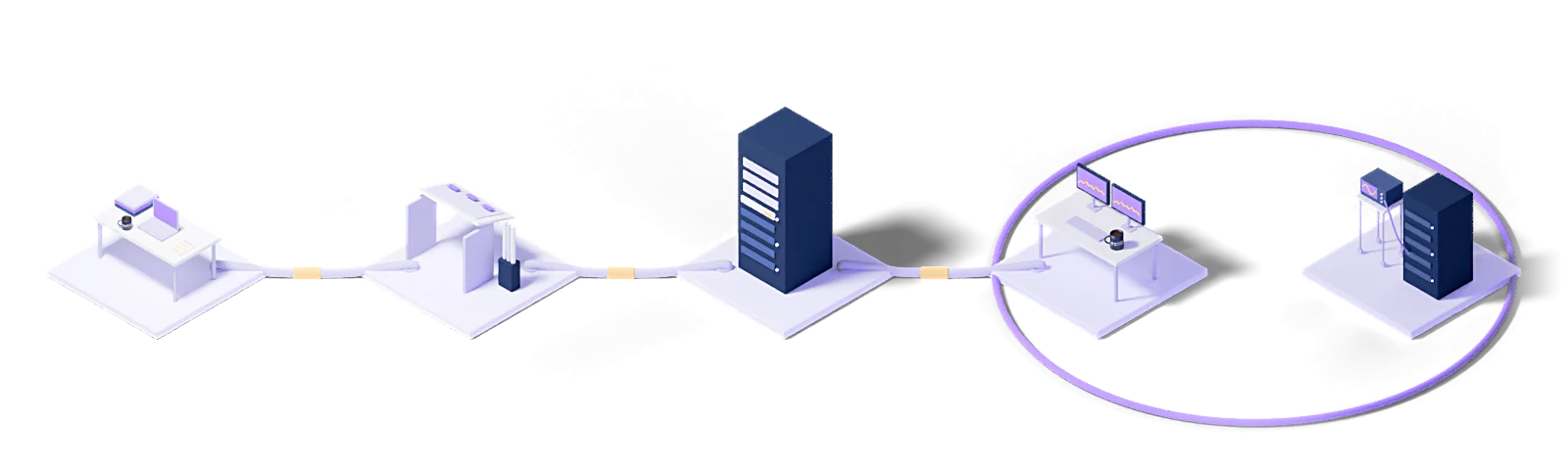
Every engagement follows the same five steps: baseline the current state, design the target model, roll out in stages, operate it, and improve against measurements.
Assess
Baseline the current state, name the gaps and put the success criteria in writing.
Design
Architect the target operating model and the toolchain it needs.
Deploy
Implement, configure and validate in a staged rollout.
Operate
24/7 management with contracted response times and proactive monitoring.
Improve
Continuous improvement driven by metrics, incidents and changes in the business.
Every engagement runs under a written SLA: a commitment, not a best-effort promise.
Dedicated engineers who know your stack. No generalist help-desk tier in between.
Service reviews every two weeks, roadmap updates every quarter.
Who uses this
The industries we run Datacenter & Infrastructure Engineering for.
The technologies we run this on
The concepts behind this service
- Edge computing
- Processing close to where data is produced rather than in a central data center.
- Physical server
- A server running directly on hardware, not virtualized.
- Colocation
- Housing your own server and network hardware in rented rack space at a data center.
- Data center
- A facility housing server, storage and network hardware with power, cooling and physical security.
This section explains the technical terms used on this page. The definitions come from Eclit's own technology glossary, and each term links through to its full entry there.
The full technology glossary →Knowledge Hub
What we have written about running and managing technology, collected in one place.
What Is a Data Center? Tier Levels and Colocation
8 min readWhat Is a Disaster Recovery Site (FKM)? How to Build One and Who Must Have It
9 min readWhat Is a Server? How Servers Work and the Main Types
7 min readVMware Licensing Changed: Should We Move to Proxmox?
5 min readDisaster Recovery Strategy for Enterprises: Zerto, Veeam and the RPO/RTO Decision
7 min readAI Infrastructure: Should You Buy GPUs or Rent Them?
5 min readWhat Is Hyperconverged Infrastructure (HCI)?
8 min readWhat Is a GPU? GPU vs CPU and the Role of GPUs in AI
7 min readWhat Is a Network Switch? Types and Switch vs Router
10 min readWhat Is a VLAN? Virtual LANs, Trunk and Access Ports
9 min readWhat Is RAID? RAID 0, 1, 5, 6 and 10 Explained
9 min readWhat Is Machine Learning? Deep Learning and Neural Networks
9 min readWhat Is Edge Computing? Architecture and Use Cases
10 min read01What is the data center service, and what does it cover?
Hosting your hardware in data centers in Türkiye (colocation) and the engineering of that layer: rack layout and weight distribution, power and cooling capacity calculated in advance, a cabling and labeling standard, migration projects planned with a downtime budget, and reporting of capacity and energy consumption. Power, cooling and physical security belong to the facility; day-to-day operation of the hardware is ours if you want it.
02Can it be used as a disaster recovery site (FKM) as well?
Yes. Colocation for those who want to build a second facility with their own hardware; our DRaaS model for those who want a ready recovery environment without installing hardware, described on the Disaster Recovery & Business Continuity page. In both cases the second facility must not share the primary center's risks, and the switch-over must be measured in a drill.
03Do you offer colocation?
Yes. Your servers, storage and network hardware are hosted in data centers in Türkiye; power, cooling and physical security are part of the service. If you want, we also take on rack layout, cabling and the day-to-day operation of the hardware.
04What should we look for when choosing a data center?
A tier rating on its own is not enough: whether power genuinely arrives on two independent feeds, cooling redundancy, carrier diversity and the latency between you and the facility all matter. So do the transfer and exit clauses: some facilities are easy to enter and hard to leave.
05Colocation, our own server room, or cloud?
It depends on how predictable the capacity is and who takes on the hardware lifecycle. Predictable, long-lived workloads are usually cheaper in colocation; variable ones in the cloud. Your own server room only makes sense if you can genuinely operate power, cooling and physical security.
06How much downtime does a migration involve?
It varies by system. Where replication can pre-synchronize, cutover is measured in minutes; hardware that has to move physically needs a window measured in hours. Migration waves are planned so each wave has a known downtime budget.
07Do you apply a cabling and labeling standard inside the rack?
Yes. Rack layout, power distribution, and color and label schemes are defined in writing. This shortens the time it takes to find the right cable during a fault, which is where a significant share of incident time is lost.
08Do you report capacity and power consumption?
Yes: rack occupancy, power draw, power density and cooling headroom. Before new hardware goes in, the rack's power and cooling budget is verified by measurement.
Let's work out where to start
Within two weeks you get it in writing: what works, what carries risk, and a prioritized roadmap.
Request a conversation