DevOps & Platform Engineering
We build and operate the engineering platforms your development teams rely on to ship faster. From CI/CD pipeline architecture and GitOps workflows to internal developer platforms (IDP) and golden-path toolchains, our platform engineers work alongside your teams to speed up delivery without giving up reliability or governance.
What we deliver
Design and implementation of enterprise-grade CI/CD pipelines using GitHub Actions, GitLab CI, Jenkins, and Tekton. We build standardized pipeline templates, enforce quality gates, and integrate security scanning (SAST/DAST/SCA) into every build.
Implementation of GitOps workflows using ArgoCD or FluxCD, declarative application delivery where Git is the single source of truth. We configure canary deployments, feature flags, and automated rollback on health degradation.
We design and build internal developer platforms using Backstage, Port, or custom solutions, giving developers self-service access to environments, templates, and services without bottlenecking on ops or platform teams.
Terraform and Pulumi module libraries for cloud resources, with state management, drift detection, and policy-as-code enforcement using Checkov or OPA. We build reusable, versioned IaC that teams can use without specialist knowledge.
Embedding observability into the platform layer: golden signals (latency, traffic, errors, saturation), SLO dashboards, deployment tracking, and DORA metrics, giving engineering leaders a clear view of delivery performance.
Integration of security controls throughout the software supply chain: container image signing (Cosign), SBOM generation, secret scanning, dependency vulnerability tracking, and policy enforcement at the pipeline gate.
How it works
Every engagement follows the same five steps: baseline the current state, design the target model, roll out in stages, operate it, and improve against measurements.
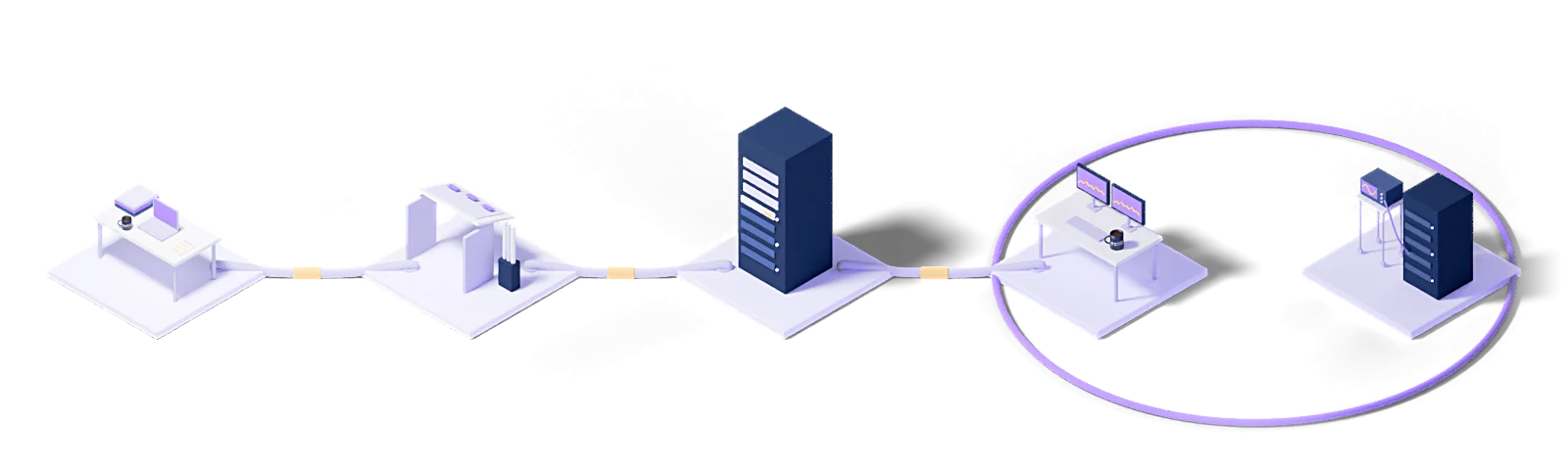
Assess
Baseline the current state, name the gaps and put the success criteria in writing.
Design
Architect the target operating model and the toolchain it needs.
Deploy
Implement, configure and validate in a staged rollout.
Operate
24/7 management with contracted response times and proactive monitoring.
Improve
Continuous improvement driven by metrics, incidents and changes in the business.
Every engagement runs under a written SLA: a commitment, not a best-effort promise.
Dedicated engineers who know your stack. No generalist help-desk tier in between.
Service reviews every two weeks, roadmap updates every quarter.
The technologies we run this on
The concepts behind this service
- Agility
- The ability to adapt quickly to changing business needs.
- DevOps
- A way of working that removes the wall between development and operations.
- PaaS (Platform-as-a-Service)
- A platform for building and running applications, delivered as a service.
- IaC (infrastructure as code)
- Defining and building infrastructure in code rather than by hand.
This section explains the technical terms used on this page. The definitions come from Eclit's own technology glossary, and each term links through to its full entry there.
The full technology glossary →Knowledge Hub
What we have written about running and managing technology, collected in one place.
Reliability Friday 11: Terraform Drift, and Why "No changes" Is Not Proof
4 min readWhat Is Kubernetes? Pods, Nodes and Clusters Explained
9 min readEveryone Uses Terraform, but Who Is Catching the Drift?
3 min readEveryone Runs Prometheus: So Why Do We Still Hear About Incidents Late?
4 min readWhy Everyone Wants Sovereign AI but Only 29% Are Building It
3 min readPlatform Engineering in 2026: Did the 80% Prediction Come True?
7 min readWhat Is Git? GitHub vs GitLab Explained
10 min readWhat Is DevOps? The DevOps Engineer Role and DORA Metrics
9 min readWhat Is CI/CD? Continuous Integration, Delivery and Jenkins
10 min readWhat Is MLOps? Running Machine Learning Models in Production
9 min read01What is the difference between platform engineering and DevOps?
DevOps is a way of working; platform engineering is building the infrastructure that makes it possible, treated as a product. In practice, that means an internal platform that lets developers create environments, ship releases and observe them on their own, instead of every team inventing its own answer.
02What does an internal developer platform buy us?
A new service that is monitored, backed up and secure from day one. When those come built into the template, no team has to rebuild them, and nobody forgets to install a monitoring agent.
03Does it restrict developer freedom?
Built properly, the opposite: the standard path becomes easy, and stepping outside it stays possible but becomes a deliberate decision. Platforms that feel restrictive are usually the ones built without asking their users.
04How soon do we see results?
The first concrete output (provisioning from a template) usually arrives within weeks. A full platform takes months but is delivered in stages: the most-used flow first, then the rest.
05Who maintains the platform afterwards?
It depends on the model. We can operate it, hand it to your team, or run it jointly. On handover the platform itself is delivered as code.
Let's work out where to start
Within two weeks you get it in writing: what works, what carries risk, and a prioritized roadmap.
Request a conversation