What Is a Disaster Recovery Site (FKM)? How to Build One and Who Must Have It
A disaster recovery site is the second facility where systems come back up when the primary data center fails. Site types, location, BDDK, SPK and SEDDK rules.
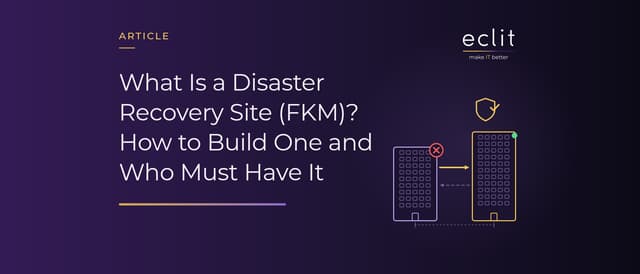
Short answer: A disaster recovery site is the second facility where critical systems are brought back up when the whole primary data center becomes unusable. The same thing goes by several names: secondary data center, backup data center, DR site; in Türkiye it is the FKM (felaket kurtarma merkezi), banking regulation calls it the "secondary center", and the finance sector also uses "emergency center (ODM)". Two properties define it, not the hardware: it must not share the primary center's risks, and the switch to it must have been measured in a drill. Banks, capital market institutions and insurers must keep their secondary systems inside Türkiye; for banks and capital markets the ceiling for resuming operations after a disaster is 24 hours.
What is a disaster recovery site?
A data center is not designed against the loss of the whole facility, only of single components inside it: fire, flood, earthquake, a prolonged power outage or ransomware that encrypts the entire environment can take one building out completely. According to Uptime Institute's 2025 survey, half of operators had a service-affecting outage in the last three years. The DR site is the answer to that scenario: a facility that keeps enough hardware, data and connectivity ready somewhere else to take the primary center's place.
Several names are used in Türkiye for the same facility. The BDDK regulation for banks says "secondary center" and defines it as the structure where secondary systems are kept ready for use, where staff can work when the primary systems are interrupted, and which is built "so as not to carry the same risks as the primary center". The finance sector also uses the name emergency center (ODM); the Central Registry Agency (MKK) calls its own backup facility the Emergency Data Center. All of them mean the same thing: the second address where the business keeps running. The short definition is in the glossary.
How it differs from backup and high availability
Backup brings the data back; the DR site brings the business back. Even with a backup in hand, the servers, the network, the identity infrastructure and the dependency order of the applications have to be rebuilt somewhere, and that somewhere is the DR site. High availability, on the other hand, absorbs the failure of a single component inside the same data center within seconds; it is not something that kicks in when the whole building is gone. Our disaster recovery article puts the three concepts side by side; the DR site is the physical counterpart of the plan described there.
Hot, warm and cold sites
NIST SP 800-34 classifies alternate sites by readiness: a cold site has power, cooling and communications but no computing equipment; a warm site has some or all of the hardware and software installed; a hot site waits fully operational with hardware and software; a mirrored site has data replicated in real time. Two numbers drive the choice: the amount of data you can afford to lose (RPO) and the time you must be back within (RTO). Targets measured in minutes call for a hot or mirrored site; targets measured in hours can be met with a warm site; with targets measured in days even a cold site may be enough. How to derive the two numbers is in How to calculate RPO and RTO.
Where should the DR site be?
The first question in choosing a location is not distance but independence: the DR site must not share the same earthquake, the same flood, the same power grid or the same communications backbone as the primary center. The SPK's 2025 communiqué says it outright: the location of the secondary system is chosen so that it is not exposed to the same risk as the primary system in natural and environmental disasters. In practice that can mean a DR site in another province for a primary center in Istanbul; AFAD's Türkiye Earthquake Hazard Map is enough to compare the hazard level of two addresses. The Central Registry Agency's 2025 drill is a concrete example: the scenario is the loss of the data center in Istanbul, and transactions run from the start of the day on the backup center in Ankara.
Distance has a price. Synchronous replication, which has every write acknowledged on both sides, adds latency as distance grows; distant DR sites use asynchronous replication and accept an RPO to match. The location decision and the RPO decision are therefore made together. Then the practical questions: are there at least two independent communication links between the centers, by which path (VPN, MPLS, internet) will user traffic reach the DR site, and who switches DNS and how fast?
Who must have one in Türkiye?
Three regulators have written secondary systems into the rules of their sectors:
- Banks: The Regulation on Banks' Information Systems and Electronic Banking Services (Official Gazette, 15 March 2020) requires primary and secondary systems to be kept inside Türkiye; every copy of the primary systems counts as a secondary system, whatever its generation (article 25). Even in a disaster scenario where the primary systems are completely out, the bank must be able to resume operations within 24 hours at the latest; to prove it, a drill with a real disaster scenario, operating from the secondary center, must be run at least once a year, with outsourcing providers included where present (article 28). The cloud and outsourcing side is in our BDDK article.
- Capital market institutions: The SPK's Communiqué on Principles and Procedures for Information Systems Management (VII-128.10) (Official Gazette, 13 March 2025) sets the same two conditions for everyone in its scope, from brokerage houses and portfolio custodians to crypto-asset service providers: primary and secondary systems inside Türkiye, the secondary system located so as not to carry the same disaster risk; the ceiling for resuming operations is 24 hours, the continuity plan is tested every year, and at least one copy of the backups is kept in a different geographic location (article 27).
- Insurance and pension companies: The Regulation on Internal Systems in the Insurance and Private Pension Sectors (Official Gazette, 25 November 2021) requires primary and secondary systems to be kept inside Türkiye (article 16); the business continuity plan is tested at least once a year and the results are reported to the board (article 18).
For organizations outside regulated sectors, the obligation, where there is one, comes from contracts: customer audits and tender specifications may ask for a business continuity plan and drill records. How to run the drill so the plan does not stay on paper is in disaster recovery testing.
Your own DR site or DRaaS?
A traditional DR site means hardware you own in a second facility under your control: maximum control, but you pay for idle capacity and carry the operational load of keeping the second facility current. DRaaS is a recovery environment hosted and operated by a provider; capital expenditure turns into operating expense and the responsibility for keeping the target environment ready moves to the provider. In Eclit's DRaaS model your critical systems stand by in our data centers in Türkiye and come up there when disaster strikes. The comparison of the two models and the hybrid setup is in enterprise disaster recovery strategy.
What does a DR site service cover?
In a DR site contract, "space and racks" is the smallest item. What to look at:
- Capacity: Are the processors, memory and storage to run all critical systems at once reserved at the DR site, or assumed to be available on the day?
- Replication: Which systems are replicated synchronously and which asynchronously; is the RPO written down for each system?
- Network and identity: IP plan, DNS switch-over, VPN and MPLS paths, the domain controller's replica at the DR site; if the servers are up but users cannot log in, recovery is not complete.
- Copy of the backups: For the ransomware scenario, is an immutable copy of the backups also kept on the DR side?
- Drills: How many times a year, in what scope, without touching production; can the results report and the measured time be handed to an auditor?
- Failback: When the disaster is over, how and in how many hours will the data produced at the DR site be moved back to the primary center?
How these items are run on Eclit's side is on the disaster recovery and business continuity page; if you want to host your own hardware, the colocation side is on the data center services page.
Frequently asked questions
What does FKM mean? Felaket kurtarma merkezi, Turkish for disaster recovery site: the second facility, not sharing the primary center's risks, where critical systems are brought back up when the primary data center fails.
Are ODM and FKM the same thing? Yes. Emergency center (ODM) is the name used in the finance sector for the same facility; banking regulation says "secondary center", English sources say "DR site".
Is a backup data center different from a DR site? Not in usage; both describe the secondary facility. The technical difference is the readiness level: cold, warm, hot or mirrored site.
How far should the DR site be from the primary center? The regulations give no kilometers; the condition is not sharing the same natural and environmental disaster risk. In practice that means another province; the greater the distance, the harder synchronous replication becomes, so the RPO decision is made together with the location decision.
Is a DR site mandatory? Banks, capital market institutions and insurers must keep secondary systems inside Türkiye; banks and capital markets have a 24-hour ceiling for resuming operations and at least one drill a year. In other sectors the obligation comes from contracts and customer audits.
What determines the cost of a DR site service? The capacity kept ready (hot or warm), the type and bandwidth of replication, drill frequency and the scope of operations the provider takes on. Organizations that do not want to pay for idle capacity turn to the DRaaS model.
Sources
- Official Gazette, Regulation on Banks' Information Systems and Electronic Banking Services: secondary center definition (article 3), in-country requirement (article 25), 24 hours and annual drill (article 28) (15 March 2020)
- Alomaliye, SPK Communiqué on Principles and Procedures for Information Systems Management (VII-128.10): scope (article 2), location of secondary systems, 24 hours and testing (article 27) (13 March 2025)
- Pension Monitoring Center, Regulation on Internal Systems in the Insurance and Private Pension Sectors: in-country requirement (article 16), business continuity testing (article 18) (25 November 2021)
- Central Registry Agency, General Letter 1041: 2025 Emergency Drill: Istanbul scenario, Emergency Data Center in Ankara (29 May 2025)
- NIST, SP 800-34 Rev. 1 Contingency Planning Guide for Federal Information Systems: cold, warm, hot and mirrored site definitions
- Uptime Institute, Global Data Center Survey 2025: share of operators with an outage (July 2025)
- How we run this layer: disaster recovery and business continuity (DRaaS)