Managed Cloud Services
Cloud servers, storage and networking as a service (IaaS) from data centers in Türkiye, plus management of your public cloud accounts: we take on monitoring, backup and day-to-day operations.
What we deliver
Management of AWS, Azure and GCP, from provisioning to cost governance and ongoing optimization.
We design and operate private cloud infrastructure that meets your data residency, compliance and performance requirements.
Continuous right-sizing, reserved instance planning and waste elimination to reduce your cloud bill by an average of 30%.
A proven migration methodology (assess, plan, migrate and validate) with minimal disruption to your operations.
Built-in security controls, policy guardrails and compliance monitoring across every cloud account you run.
Autoscaling and multi-region redundancy to handle traffic spikes and eliminate single points of failure.
How it works
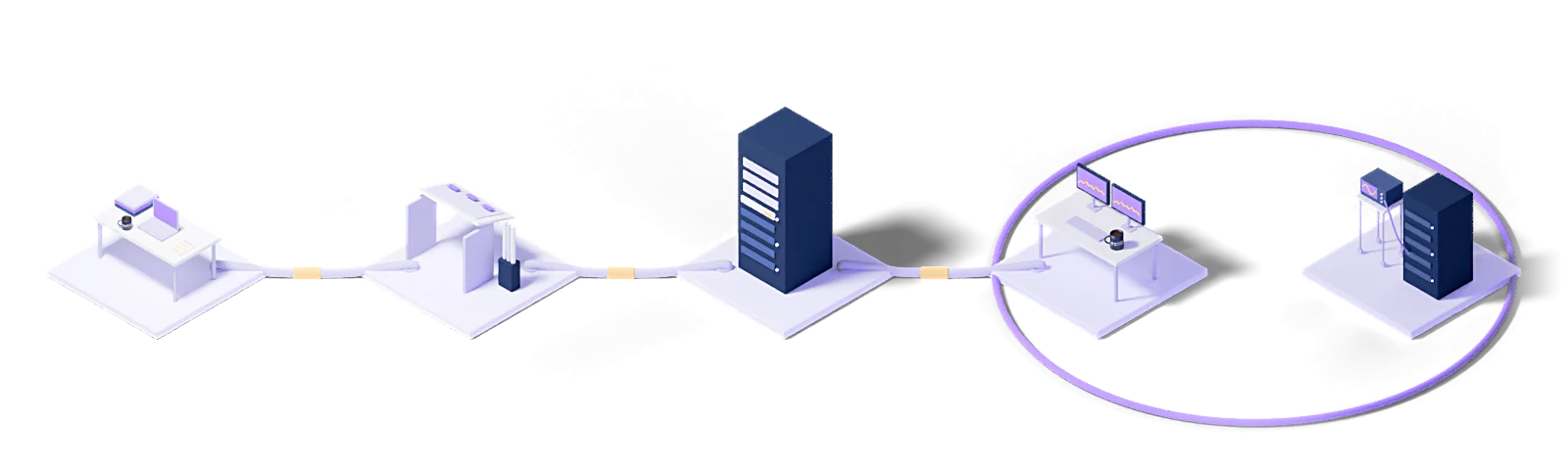
Every engagement follows the same five steps: baseline the current state, design the target model, roll out in stages, operate it, and improve against measurements.
Assess
Baseline the current state, name the gaps and put the success criteria in writing.
Design
Architect the target operating model and the toolchain it needs.
Deploy
Implement, configure and validate in a staged rollout.
Operate
24/7 management with contracted response times and proactive monitoring.
Improve
Continuous improvement driven by metrics, incidents and changes in the business.
Every engagement runs under a written SLA: a commitment, not a best-effort promise.
Dedicated engineers who know your stack. No generalist help-desk tier in between.
Service reviews every two weeks, roadmap updates every quarter.
The concepts behind this service
- Cloud server
- A server running on virtualized resources and managed remotely, with no hardware to buy.
- Hosting
- Running a website or application, or storing data, on a provider's infrastructure.
- Infrastructure-as-a-Service (IaaS)
- Infrastructure (servers, storage, network) delivered as a service.
- VDS
- Virtual dedicated server — running on shared physical hardware but with resources allocated to a single customer.
- VPS
- Virtual private server — a partition of a physical server with its own operating system and allocated resources.
- Managed cloud
- Monitoring, management, security and cost tracking of cloud infrastructure taken on by a provider.
This section explains the technical terms used on this page. The definitions come from Eclit's own technology glossary, and each term links through to its full entry there.
The full technology glossary →Knowledge Hub
What we have written about running and managing technology, collected in one place.
What Is a Cloud Server? How It Works and How to Choose One
10 min readWhat Is a VDS? Difference from VPS, How It Works, How to Choose One
7 min readWhat Is IaaS? IaaS vs PaaS vs SaaS
7 min readWhat Is a Server? How Servers Work and the Main Types
7 min readWhat Is a Virtual Machine (VM)? Virtual vs Physical Servers
7 min readWhat Is Hybrid Cloud? When Is It the Right Choice?
6 min readWhat Is an MSP? A Guide to Managed Services
10 min readKVKK Cross-Border Data Transfer: What to Check When Using the Cloud
5 min readBDDK Treats Cloud as Outsourcing: What Changes for Banks
5 min read10 Questions to Ask When Choosing a Managed Service Provider
5 min readWhat Is Cloud Computing? Cloud Models and Types
7 min readWhat Are CAPEX and OPEX? The Difference in IT Spending
7 min read01What is the managed cloud server service, and what does it cover?
We provide cloud servers, storage and networking as a service (IaaS) from data centers in Türkiye and run the operating system layer on top: monitoring, patching, backup and incident response. Resources can be scaled online; the service level and the boundary of responsibility are written into the contract.
02What is the difference between managed cloud and IaaS?
With IaaS you get compute, storage and network as a service; the operating system and everything above it stay with you. With managed cloud we also run the operating system layer: monitoring, patching, backup and incident response. Where responsibility ends is written into the contract.
03Is a cloud server or VPS the same as managed cloud?
No. With a cloud server you rent the capacity and do the setup and maintenance yourself. With managed cloud the infrastructure is designed around your workload; monitoring, backup and updates are our job, and the service level is defined in the contract.
04Where does your hosting run?
In data centers in Türkiye. For organizations with a data residency requirement the location is written into the contract; if an overseas region is preferred, that is defined explicitly too.
05Can I scale up immediately if I need more resources?
Yes, CPU, memory and disk can be increased online. Scaling down is possible too, but it is done as a planned change. We monitor usage trends and let you know before a threshold is reached.
06Are my servers backed up?
Backup is in scope and the retention period is defined in the contract. Regular restore drills prove the backups actually come back, which matters more than the fact that they exist.
07How will I know if there is an outage?
Monitoring raises an alert automatically and an incident record is created; the notification path and timing are defined in the contract. Learning about an outage from the customer means the monitoring is not working.
08Can I bring my own licenses?
For most products yes: Windows Server, SQL Server and similar. We check in advance whether the license model permits hosting, because not every license type can be used on third-party infrastructure.
Let's work out where to start
Within two weeks you get it in writing: what works, what carries risk, and a prioritized roadmap.
Request a conversation