Storage & Data Infrastructure (incl. Ceph)
We design and operate storage infrastructure: block, file and S3-compatible object storage, Ceph-based software-defined platforms, capacity planning and data tiering.
What we deliver
Day-to-day operation of SAN, NAS and object storage, with capacity, latency and IOPS monitored so we can step in before anything saturates.
Ceph-based block, file and object storage built and operated: a hardware-independent, scalable storage layer where growth is met by adding nodes.
Hot, warm and cold data separated and placed on the appropriate tier by access frequency, so performance and cost are managed together.
We measure the growth curve so capacity needs are visible well in advance. Decisions forced by a full disk always cost more than planned ones.
Snapshot policies, retention periods and replication to a second location, with recovery points tested to confirm they actually work.
Encryption at rest, key management and access control, with deletion and destruction processes run in a documented, verifiable way.
How it works
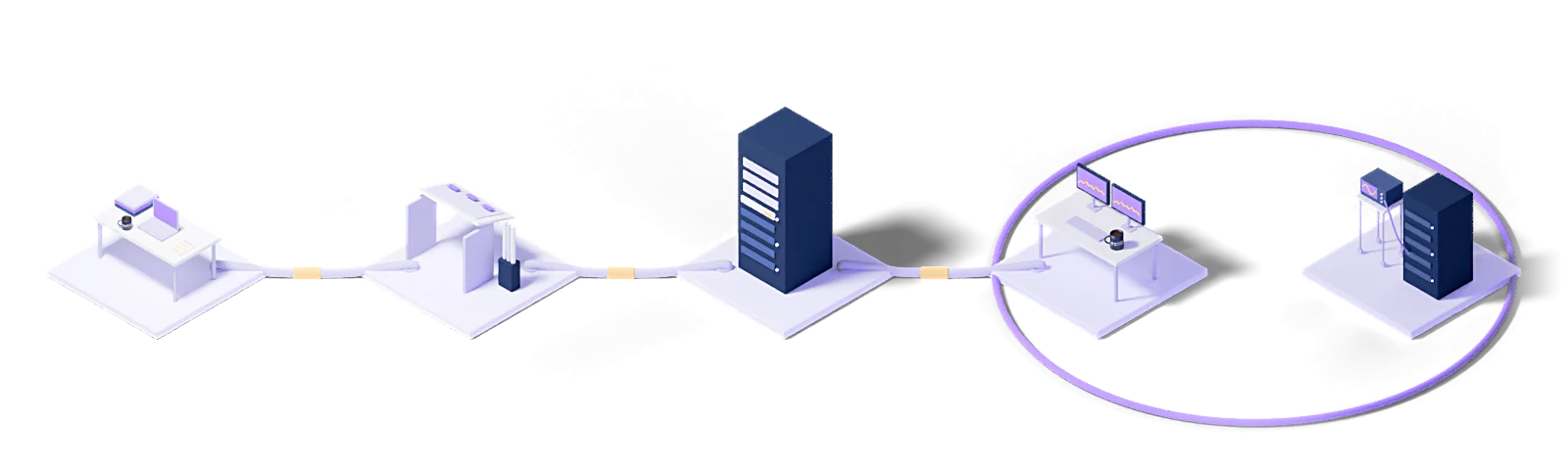
Every engagement follows the same five steps: baseline the current state, design the target model, roll out in stages, operate it, and improve against measurements.
Assess
Baseline the current state, name the gaps and put the success criteria in writing.
Design
Architect the target operating model and the toolchain it needs.
Deploy
Implement, configure and validate in a staged rollout.
Operate
24/7 management with contracted response times and proactive monitoring.
Improve
Continuous improvement driven by metrics, incidents and changes in the business.
Every engagement runs under a written SLA: a commitment, not a best-effort promise.
Dedicated engineers who know your stack. No generalist help-desk tier in between.
Service reviews every two weeks, roadmap updates every quarter.
Who uses this
The industries we run Storage & Data Infrastructure (incl. Ceph) for.
The concepts behind this service
- Cloud storage
- Storing data in a service reached over the internet.
- LUN
- A logical unit presented to a server by a storage system.
- Object storage
- A storage model that keeps data as objects, each with its ID and metadata, in a flat namespace instead of a folder hierarchy.
- Snapshot
- A record of a system or volume at a point in time.
- Data storage
- Holding data persistently.
- Managed storage
- Operation of storage infrastructure as a service, including capacity planning, performance monitoring, snapshot policy and growth management.
This section explains the technical terms used on this page. The definitions come from Eclit's own technology glossary, and each term links through to its full entry there.
The full technology glossary →Knowledge Hub
What we have written about running and managing technology, collected in one place.
What Is Object Storage? How It Differs from Block and File Storage
7 min readWhat Is NAS? Network Attached Storage vs SAN
9 min readWhat Is RAID? RAID 0, 1, 5, 6 and 10 Explained
9 min readYou Have Backups, but Can You Recover? Veeam, Zerto and the Recovery Gap
3 min readHow to Calculate RPO and RTO Without Guessing
4 min readPostgreSQL or MongoDB? The Answer Depends on Access Patterns, Not Data Shape
4 min readWhat Is Hyperconverged Infrastructure (HCI)?
8 min readWhat Is Replication? Synchronous vs. Asynchronous Replication
7 min read01What is the difference between block, file and object storage?
Block storage attaches to a server like a raw disk; databases and virtual machine disks run on it. File storage keeps data in a folder hierarchy and shares it over the network (NFS, SMB). Object storage keeps each piece of data with its ID and metadata in a flat namespace, reached over an HTTP API. It is used for backups, archives and large volumes of unstructured data.
02Do you build S3-compatible object storage?
Yes. Ceph's object storage layer (the Ceph Object Gateway) is compatible with a large subset of the Amazon S3 API, so backup software and applications that speak S3 can connect to it. Object Lock, which keeps backups immutable against ransomware, is configured on the same layer.
03How do we choose between Ceph and enterprise storage arrays?
We compare the capacity growth curve, the performance profile and total cost of ownership. Ceph scales without license costs and suits large capacity that grows predictably; enterprise arrays offer lower latency and vendor support. Environments running both are common.
04Do you operate our existing storage array?
Yes. We operate NetApp, Dell EMC, HPE and IBM arrays: capacity planning, pool and LUN management, firmware updates, replication and fault tracking.
05Can you tell us in advance when capacity will run out?
Yes. The growth curve is measured and the monthly report gives a date for when utilization reaches the critical threshold. The aim is to give that date far enough ahead to absorb procurement lead time.
06Do snapshots replace backups?
No. A snapshot lives on the same array; lose the array and you lose the snapshot. It is valuable for fast rollback but it does not replace a backup: they are separate controls and are planned separately.
07Is there downtime during a storage migration?
Online migration methods move most workloads without interruption. Cases that do require downtime are identified up front and scheduled into a maintenance window; the migration order follows application dependencies.
Let's work out where to start
Within two weeks you get it in writing: what works, what carries risk, and a prioritized roadmap.
Request a conversation