Database Platform & Operations (DBA)
24/7 database platform management. Backup and restore evidence, performance tuning, replication health and version lifecycle, all handled with engineering discipline.
What we deliver
Continuous operation of PostgreSQL, Oracle, SQL Server, MySQL and MongoDB estates. Locks, long-running queries and connection saturation monitored, with incidents handled through a defined on-call rotation.
Periodic restore tests confirm that backups can actually be restored, with the measured duration and outcome reported.
Execution plan analysis, index strategy, statistics freshness and connection pool settings. The cause of slowness is measured; scaling up the server is the last option, not the first.
Standby lag measured through the database's own replication views, with write, flush and apply stages read separately so the bottleneck is identified as network, disk or apply, not guessed.
Major and minor upgrades planned, compatibility tested, maintenance windows managed and a rollback path kept open at each step.
Privileged database accounts segregated, access records collected, and the evidence an audit will ask for kept ready.
How it works
Every engagement follows the same five steps: baseline the current state, design the target model, roll out in stages, operate it, and improve against measurements.
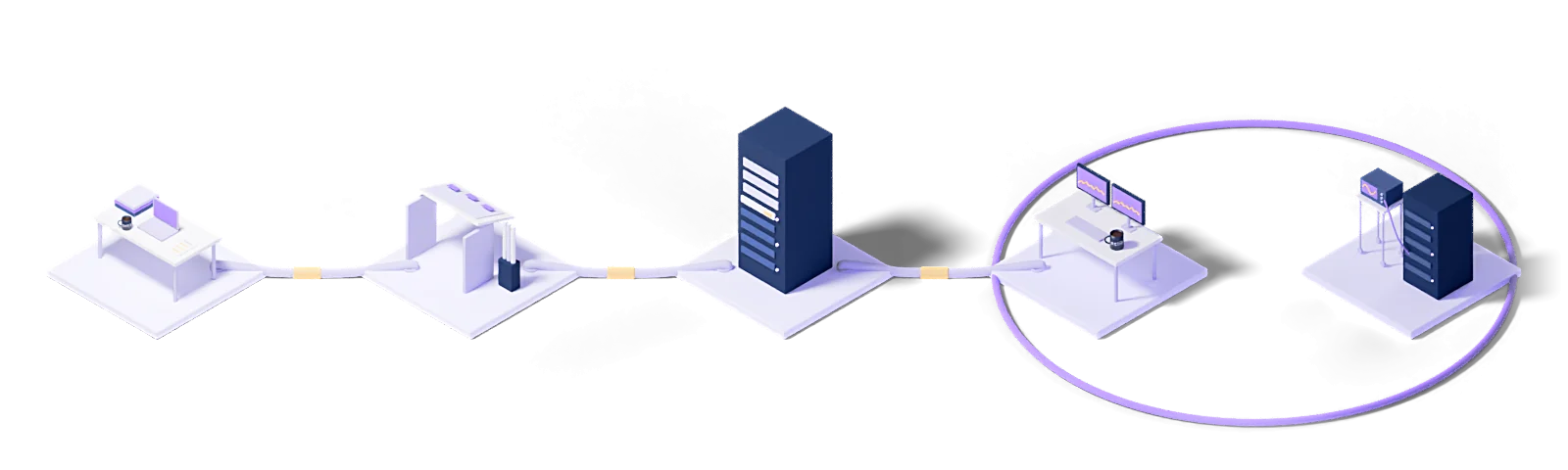
Assess
Baseline the current state, name the gaps and put the success criteria in writing.
Design
Architect the target operating model and the toolchain it needs.
Deploy
Implement, configure and validate in a staged rollout.
Operate
24/7 management with contracted response times and proactive monitoring.
Improve
Continuous improvement driven by metrics, incidents and changes in the business.
Every engagement runs under a written SLA: a commitment, not a best-effort promise.
Dedicated engineers who know your stack. No generalist help-desk tier in between.
Service reviews every two weeks, roadmap updates every quarter.
The technologies we run this on
The concepts behind this service
- Active database
- The production database serving real-time read and write traffic.
- Database
- A system where data is stored in structured form and can be queried.
- Database operations services
- Database installation, monitoring, backup, tuning and version management delivered as a service.
This section explains the technical terms used on this page. The definitions come from Eclit's own technology glossary, and each term links through to its full entry there.
The full technology glossary →Knowledge Hub
What we have written about running and managing technology, collected in one place.
What Is a DBA? What Does a Database Administrator Do?
7 min readWhat Is a Database Management System (DBMS)? Types, Examples
7 min readReliability Friday 01: How to Measure PostgreSQL Replication Lag
4 min readPostgreSQL or MongoDB? The Answer Depends on Access Patterns, Not Data Shape
4 min readHow to Calculate RPO and RTO Without Guessing
4 min readWhat Is Replication? Synchronous vs. Asynchronous Replication
7 min readWhat Is SQL? SQL Commands, MySQL and SQL Server Explained
9 min readWhat Is PostgreSQL? Features, Versions and MySQL Differences
10 min readWhat Is NoSQL? Redis, MongoDB and SQL vs NoSQL
10 min readWhat Is DBaaS (Database as a Service)? Managed Databases
10 min read01What is a database management (DBA) service, and what does it cover?
A database management service is one where you hand the operation, backup, monitoring, patching and performance of your databases to a DBA team. Eclit provides it for PostgreSQL, MySQL/MariaDB, Microsoft SQL Server, Oracle, MongoDB and Redis, 24/7 through an on-call rotation. It covers backups proven by restore tests, finding and fixing slow queries, replication lag monitoring, planned version upgrades and access records for privileged accounts. Schema changes and data ownership stay with you.
02What is a database migration service?
Database migration is moving a database to a new server, version, platform or cloud without losing data; a move from Oracle to PostgreSQL is one example. Eclit plans a migration as distinct steps: schema conversion, stored procedure analysis, data transfer and verification. Before cutover there is a dual-write period with continuous comparison, and cutover does not happen until the numbers on both sides match. Once the migration is done, we can also take over running the database 24/7.
03Which databases are in scope?
PostgreSQL, MySQL/MariaDB, Microsoft SQL Server, Oracle, MongoDB and Redis. Each has its own operations runbook; version, backup method and upgrade path differ by engine.
04How do you find and fix slow queries?
Query statistics are collected continuously and the most expensive queries are ranked by duration, call count and blocks read. Where the cause is a missing index, a bad execution plan or stale statistics, we fix it; where the query itself needs rewriting, the recommendation goes to your development team.
05Is there downtime during a version upgrade?
It depends on the method. Upgrading through logical replication or a standby node brings downtime down to minutes; an in-place upgrade takes longer. We choose the method with you, based on how much downtime you can accept.
06Do you set up high availability?
Yes, including streaming replication, automatic failover, connection routing and a witness node. After the build, the failover scenario is proven in a drill; a failover that has been configured but never tested cannot be relied on.
07We have no DBA. Can you take it over entirely?
Yes, full handover is the model most clients choose. Schema changes and data ownership stay with you; operations, backup, monitoring, patching and performance management sit with us.
Let's work out where to start
Within two weeks you get it in writing: what works, what carries risk, and a prioritized roadmap.
Request a conversation