DevOps & CI/CD Enablement
DevOps and CI/CD enablement. Build and deployment pipelines, test automation wired into the pipeline, secret management, and measured deployment performance.
What we deliver
The path from source to production automated: compile, test, package and deploy made repeatable rather than remembered.
Unit, integration and security tests wired into the pipeline, with a failing test stopping the deployment and reporting back immediately.
Passwords, keys and tokens separated from code, held in a central secret store and injected safely at run time.
An artifact repository, disciplined version tagging, and always knowing which version runs in which environment.
Every deployment reversible, with rollback from a bad release taking minutes and following a defined step rather than improvisation.
Deployment frequency, lead time for changes, change failure rate and time to restore, measured. Improvement becomes a number rather than a claim.
How it works
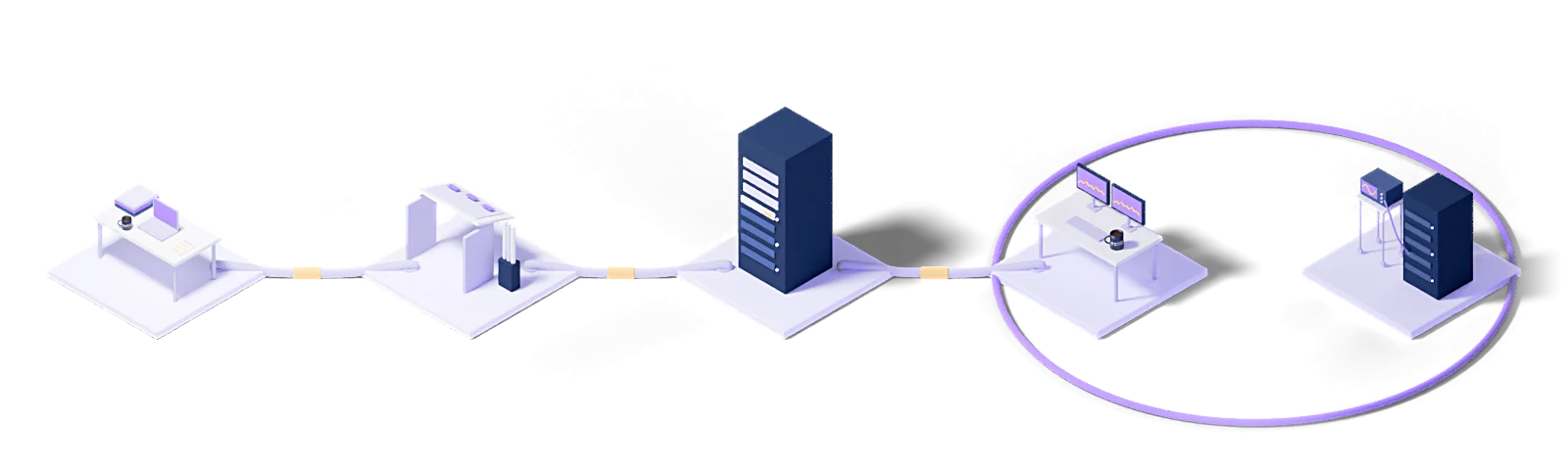
Every engagement follows the same five steps: baseline the current state, design the target model, roll out in stages, operate it, and improve against measurements.
Assess
Baseline the current state, name the gaps and put the success criteria in writing.
Design
Architect the target operating model and the toolchain it needs.
Deploy
Implement, configure and validate in a staged rollout.
Operate
24/7 management with contracted response times and proactive monitoring.
Improve
Continuous improvement driven by metrics, incidents and changes in the business.
Every engagement runs under a written SLA: a commitment, not a best-effort promise.
Dedicated engineers who know your stack. No generalist help-desk tier in between.
Service reviews every two weeks, roadmap updates every quarter.
The technologies we run this on
The concepts behind this service
- Bug
- A defect that makes software behave differently from what was expected.
This section explains the technical terms used on this page. The definitions come from Eclit's own technology glossary, and each term links through to its full entry there.
The full technology glossary →Knowledge Hub
What we have written about running and managing technology, collected in one place.
Reliability Friday 11: Terraform Drift, and Why "No changes" Is Not Proof
4 min readEveryone Uses Terraform, but Who Is Catching the Drift?
3 min readEveryone Runs Prometheus: So Why Do We Still Hear About Incidents Late?
4 min readPostgreSQL or MongoDB? The Answer Depends on Access Patterns, Not Data Shape
4 min readWhat Is Docker? Containers vs Virtual Machines
7 min readWhat Is Git? GitHub vs GitLab Explained
10 min readWhat Is DevOps? The DevOps Engineer Role and DORA Metrics
9 min readWhat Is CI/CD? Continuous Integration, Delivery and Jenkins
10 min read01How long does it take to build a CI/CD pipeline?
Days for a simple application; weeks in an organization with no test infrastructure or environment management. The timeline depends less on the pipeline itself than on whether automated tests and reproducible environments already exist.
02We have no automated tests. Is it still worth it?
Partly. Automating build, packaging and deployment lowers the error rate on its own. But without tests a pipeline can become a mechanism for delivering bugs to production faster, which is why test gates are built in parallel.
03Isn't automatic deployment to production risky?
Not with gates: automated tests, phased rollout, health checks and automatic rollback on failure. The real risk is manual deployment that is done differently every time.
04Which environments do we need?
At minimum, development, test and production, with the environments identical to each other. Differences between environments are the most common cause of production-only bugs, which is why environments are built as code.
05How do you manage secrets?
In a vault, injected at pipeline runtime; no secrets live in the repository. A key that has entered the repository stays in its history even after deletion and must be rotated.
Let's work out where to start
Within two weeks you get it in writing: what works, what carries risk, and a prioritized roadmap.
Request a conversation