AI Stack Design & Engineering
Design and build of enterprise AI infrastructure. GPU capacity, model serving, vector data layer, and data residency constraints written into the architecture from the start.
What we deliver
Capacity planning based on the distinct profiles of training and inference workloads; power, cooling and inter-node bandwidth calculated before hardware is ordered.
Serving infrastructure for running models in production: versioning, scaling, latency targets, and a defined rollback path for when a release misbehaves.
Vector database selection and setup, embedding pipelines and data preparation flows built to be repeatable rather than hand-run.
Personal and regulated data stays local while non-sensitive workloads can run elsewhere. The split is built at the start; separating later costs far more.
Quota, priority and queueing policy where several teams share the same GPU resource. Without this layer, the loudest team owns the hardware.
GPU utilization measured and reported per team. The buy-versus-rent decision is then based on data rather than estimates.
How it works
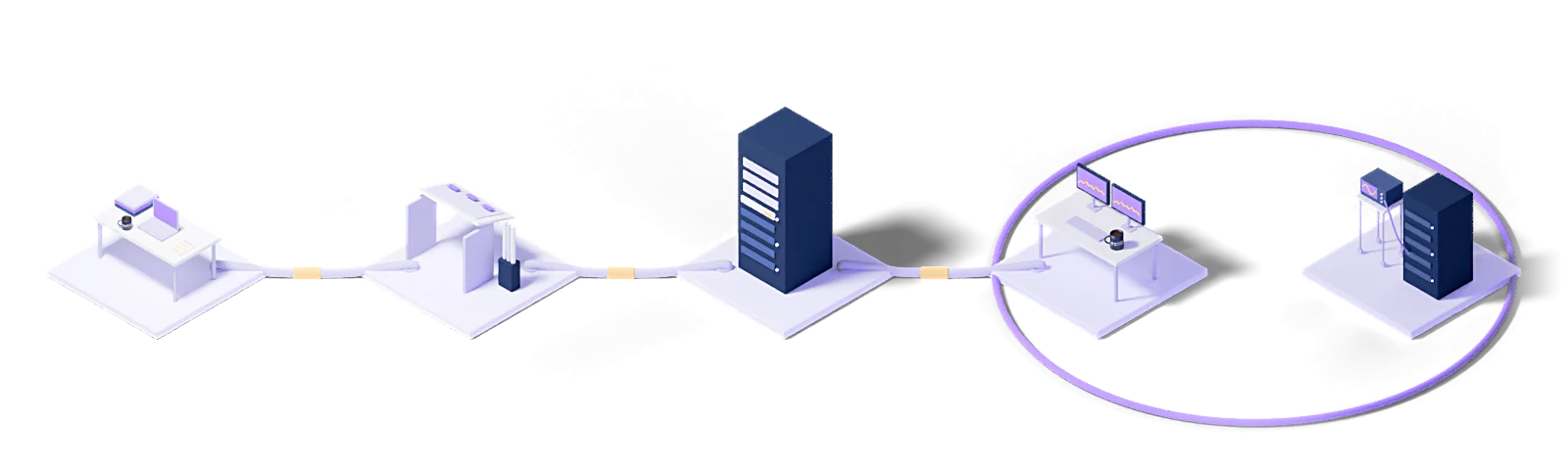
Every engagement follows the same five steps: baseline the current state, design the target model, roll out in stages, operate it, and improve against measurements.
Assess
Baseline the current state, name the gaps and put the success criteria in writing.
Design
Architect the target operating model and the toolchain it needs.
Deploy
Implement, configure and validate in a staged rollout.
Operate
24/7 management with contracted response times and proactive monitoring.
Improve
Continuous improvement driven by metrics, incidents and changes in the business.
Every engagement runs under a written SLA: a commitment, not a best-effort promise.
Dedicated engineers who know your stack. No generalist help-desk tier in between.
Service reviews every two weeks, roadmap updates every quarter.
The technologies we run this on
The concepts behind this service
- Deep learning
- The branch of machine learning that uses multi-layer neural networks to learn patterns from large datasets.
- LLM (large language model)
- An AI model that can understand and generate language, trained on very large text corpora.
- Machine learning
- Methods that predict and classify by learning from data rather than being explicitly programmed.
- Artificial intelligence (AI)
- Systems performing tasks normally considered to require human intelligence.
This section explains the technical terms used on this page. The definitions come from Eclit's own technology glossary, and each term links through to its full entry there.
The full technology glossary →Knowledge Hub
What we have written about running and managing technology, collected in one place.
What Is an LLM (Large Language Model) and How Does It Work?
7 min readWhat Is a GPU? GPU vs CPU and the Role of GPUs in AI
7 min readEnterprise AI in Türkiye: Impact Today and the 2030 Horizon
7 min readWhy Everyone Wants Sovereign AI but Only 29% Are Building It
3 min readAI Infrastructure: Should You Buy GPUs or Rent Them?
5 min readKVKK Cross-Border Data Transfer: What to Check When Using the Cloud
5 min readAI Governance: A Compliance Roadmap for Turkish Enterprises
7 min readWhy AI Projects Stall, and Why the Answer Is AI-Ready Data
6 min readWhat Is AI? How It Works, Types and Examples
9 min readWhat Is Machine Learning? Deep Learning and Neural Networks
9 min readWhat Is an AI Agent? Agentic AI and How AI Agents Work
10 min readWhat Is n8n? What It Does, Deployment Options and Licensing
6 min readWhat Is OCR? How It Works, Use Cases and Limits
6 min readWhat Is MCP (Model Context Protocol)? Servers and Security
9 min readWhat Is RAG (Retrieval-Augmented Generation)? How It Works
10 min readWhat Is MLOps? Running Machine Learning Models in Production
9 min readWhat Is Data Poisoning in AI, and How Do You Prevent It?
9 min readWhat Is ISO/IEC 42001? The AI Management System (AIMS)
9 min read01Should we build our own AI infrastructure or use a hosted service?
It depends on how sensitive your data is and how much of it you process. If you work with data that must stay inside the organization, you need your own; for non-sensitive data at low volume, a hosted service is far cheaper. Mixed arrangements are common.
02Does building GPU infrastructure make sense?
It depends on utilization. With continuous training or inference load, your own GPUs can pay for themselves within a year; for occasional workloads, renting in the cloud is cheaper. We measure the usage profile first.
03Will our data be used to train the model?
On your own infrastructure, no. On hosted services it depends on the provider's terms, so we check that clause specifically: most enterprise tiers exclude training, but defaults vary by provider.
04What does a Retrieval-Augmented Generation (RAG) setup require?
A document source, a chunking and embedding pipeline, a vector database and access control. The last is the most commonly skipped: a system that answers from a document the user is not allowed to see has bypassed the permission model.
05How do we keep the cost under control?
Token usage is monitored and reported per team or application. Caching, model size selection and prompt length optimization determine most of the cost. Unmeasured AI spend gets out of hand quickly.
Let's work out where to start
Within two weeks you get it in writing: what works, what carries risk, and a prioritized roadmap.
Request a conversation